
The Passion Pick is reader-supported. When you buy through links on this page, we may earn a commission at no extra cost to you. As an Amazon Associate, we earn from qualifying purchases.
Most new telescopes come with one or two basic eyepieces, and they rarely show what the telescope can actually do. Upgrading your eyepieces is one of the cheapest ways to get sharper, brighter, more comfortable views of the Moon, planets and deep-sky objects, and to get more out of one of the most rewarding science hobbies you can take up. This guide covers how to choose the best eyepiece set for telescope beginners: what the specs mean, which designs are worth buying, and exactly which focal lengths fit your telescope.
Quick Answer: The Best Beginner Eyepiece Set
For most beginners, the best eyepiece set is three eyepieces covering low, medium and high magnification, plus an optional 2x Barlow lens. A typical starter set looks like this:
- Low power (25–32mm): for finding objects, star clusters and large nebulae
- Medium power (12–15mm): for galaxies, smaller clusters and general viewing
- High power (5–8mm): for the Moon, planets and double stars
The exact focal lengths depend on your telescope (see the table below). If you want everything in one purchase, an all-in-one beginner kit with several Plossl eyepieces and a Barlow is a convenient start. If you’d rather buy fewer but better eyepieces, a set of three wide-field eyepieces such as the BST StarGuider series is a noticeable upgrade.
Our top picks at a glance
BST StarGuider ED Eyepieces
The best eyepiece upgrade for most beginners
Budget pick
SVBONY 66° Wide-Angle Eyepieces
A wider view for a lot less money
Best all-in-one kit
Celestron 1.25″ Eyepiece and Filter Kit
Everything you need to experiment, in one case
Best Barlow add-on
Celestron Omni 2x Barlow Lens
Double every eyepiece you already own
What Does a Telescope Eyepiece Do?
Your telescope’s main lens or mirror gathers light and forms an image. The eyepiece magnifies that image for your eye. Swapping eyepieces changes your magnification and how much sky you see at once, so one telescope can go from a wide view of the Pleiades to a close-up of Saturn’s rings.
A good telescope paired with poor eyepieces will underperform. Better eyepieces improve sharpness, contrast, comfort and how much of the view stay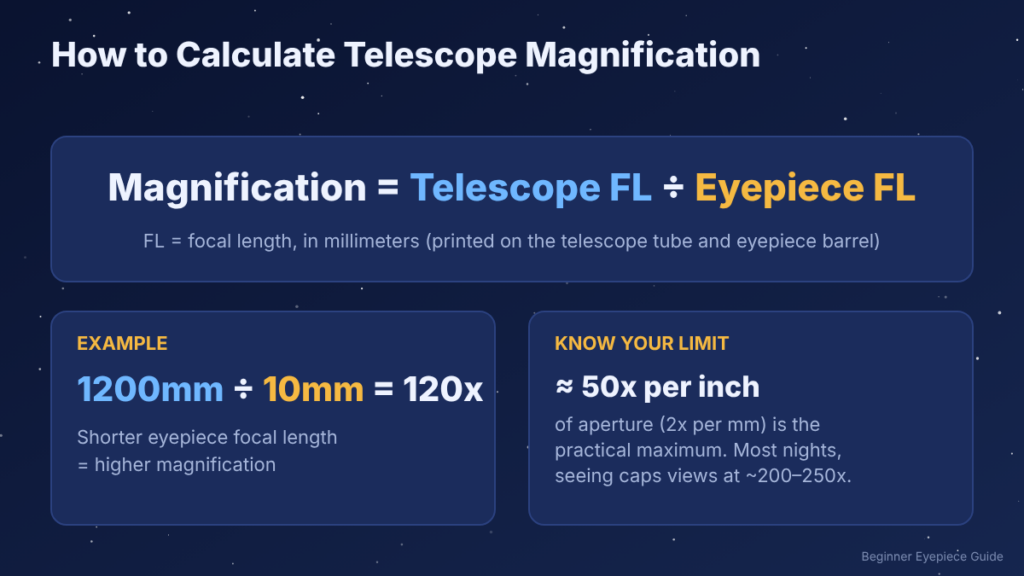 s in focus out to the edge.
Key Eyepiece Specifications Explained
Focal Length and Magnification
An eyepiece’s focal length (in millimeters, printed on the barrel) determines magnification. Shorter focal lengths give higher magnification.
Magnification = telescope focal length ÷ eyepiece focal length
For example, a telescope with a 1200mm focal length and a 10mm eyepiece gives 120x.
More magnification isn’t always better. Every telescope has a practical limit of about 50x per inch of aperture (2x per millimeter). Celestron puts the maximum usable power at 50–60x per inch, and only under ideal conditions. In practice, air turbulence (“seeing”) usually limits you well before that. As Sky & Telescope notes, experienced planetary observers typically work at 20–30x per inch. Pushing past these limits gives a bigger but blurrier, dimmer image.
Apparent Field of View (AFOV)
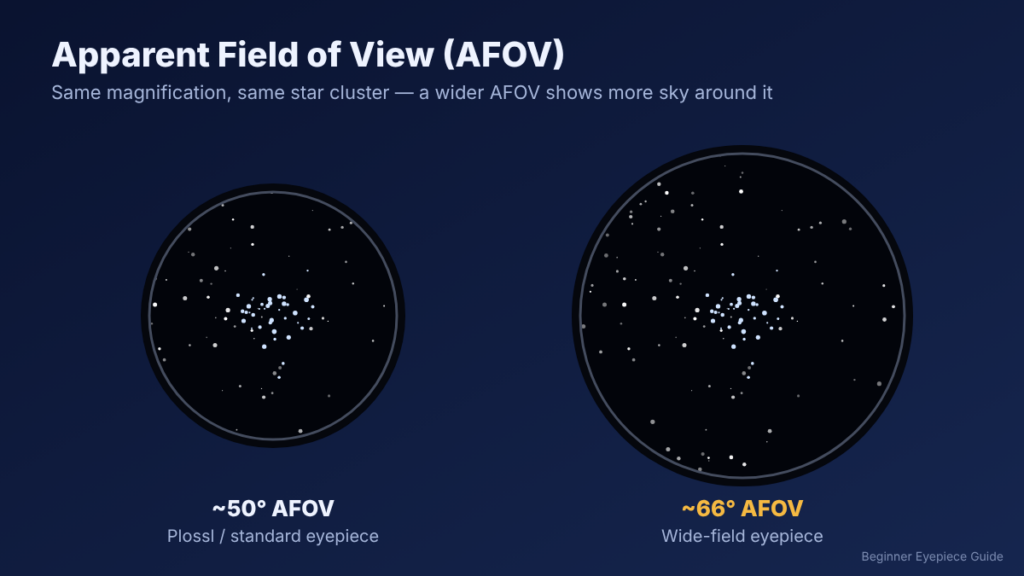
AFOV is how wide the view looks through the eyepiece, measured in degrees. Basic eyepieces offer 40–52°, mid-range designs 60–70°, and premium wide-angles 82–100°. A wider AFOV feels more immersive and makes objects easier to find and track, especially on manual mounts without tracking.
To estimate how much actual sky you’ll see (true field of view):
True field ≈ AFOV ÷ magnification
A 52° eyepiece at 50x shows about 1° of sky, roughly two full Moons side by side.
Eye Relief
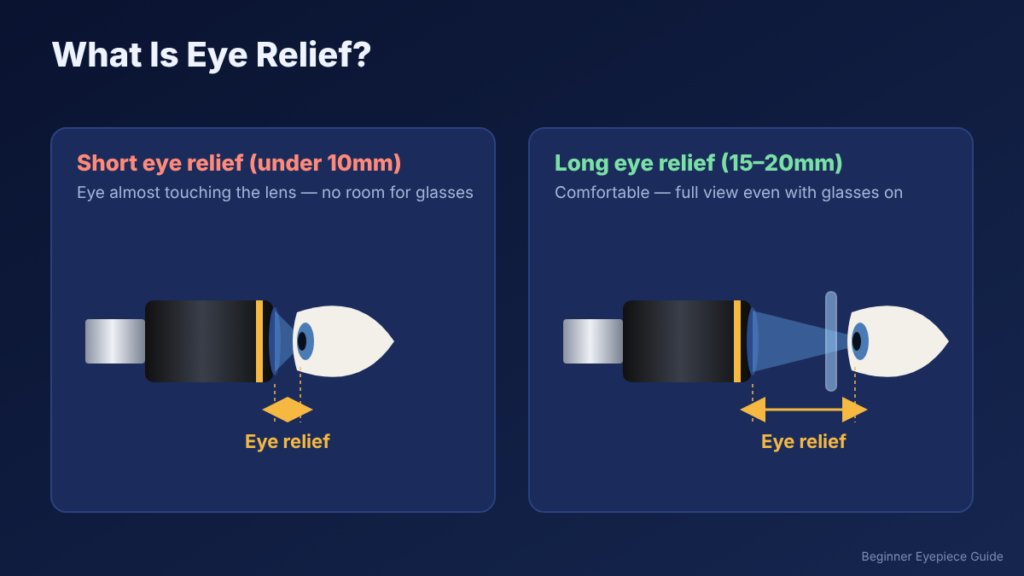
Eye relief is how far your eye can be from the lens and still see the whole field. Short eye relief means pressing your eye almost against the glass, which is uncomfortable for anyone and unworkable for glasses wearers.
- Under 10mm: cramped; difficult for most people
- 15–20mm: comfortable, and generally needed if you observe with glasses on
This is where many beginner kits fall short. Plossl eye relief shrinks as focal length drops, so 4mm and 6mm Plossls are notoriously hard to use.
Exit Pupil
The exit pupil is the width of the beam of light leaving the eyepiece. It’s a helpful way to choose focal lengths for any telescope:
Exit pupil = eyepiece focal length ÷ telescope focal ratio (f-number)
- 4–6mm: low power, wide and bright views
- 2–3mm: medium power, good for galaxies and clusters
- 0.5–1mm: high power for the Moon, planets and double stars
Sky & Telescope suggests a full eyepiece set giving exit pupils of roughly ½, 1, 2, 4 and 7mm. A beginner’s three-eyepiece set covers the most useful part of that range.
Barrel Size
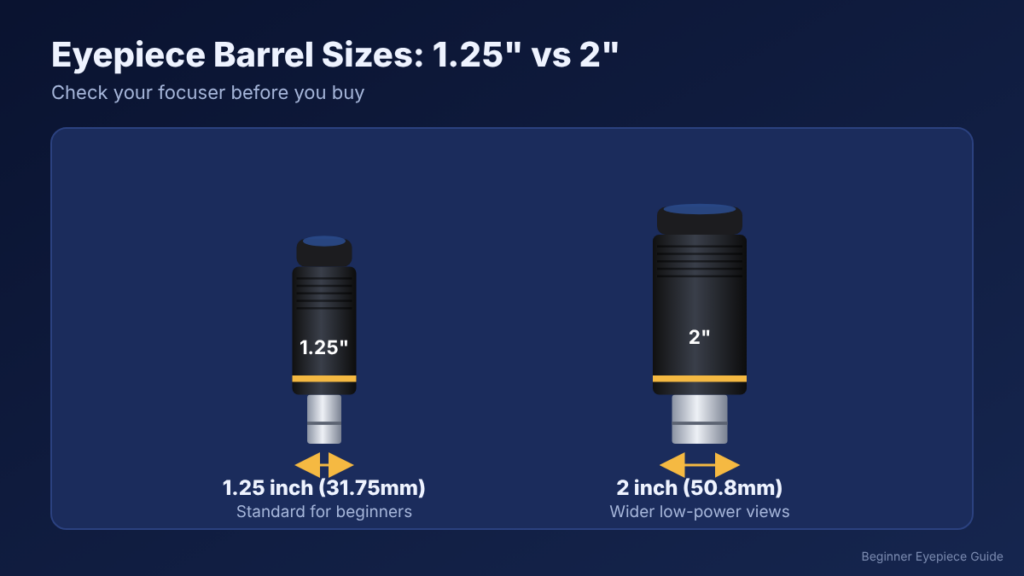
Eyepieces fit the telescope’s focuser in two standard sizes:
- 1.25-inch: the standard for beginners. Affordable, widely available and compatible with almost every telescope.
- 2-inch: allows wider fields of view at low power but costs more, weighs more and needs a 2-inch focuser.
Some very cheap telescopes use older 0.965-inch eyepieces. If yours does, upgrading usually isn’t worth it unless you can swap in a 1.25-inch diagonal or focuser.
How Your Telescope Type Affects Eyepiece Choice
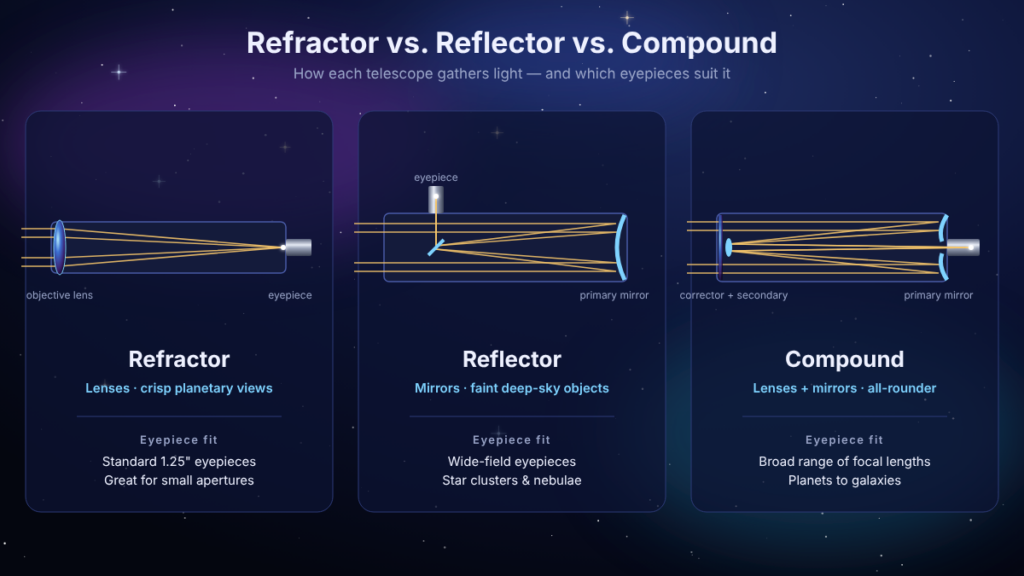
Refractor Telescopes
Refractors use lenses and are low-maintenance and quick to set up. Most beginner refractors have slower focal ratios (f/7 to f/10), which go easy on eyepieces, so even budget Plossls look sharp across the field. Small refractors (60–80mm) top out around 120–160x, so you don’t need very short focal lengths.
Reflector Telescopes (Including Dobsonians)
Reflectors use mirrors and give you the most aperture for your money, which makes them excellent for faint deep-sky objects. Dobsonians are the most popular beginner reflectors. If you’re still choosing one, see our guide to the best Dobsonian telescope. Most beginner reflectors are fast (f/4.5 to f/6). Fast scopes are demanding on eyepieces: budget designs, especially cheap wide-angles, often show blurry or stretched stars toward the edge of the view. Eyepieces like the BST StarGuider or a good Plossl handle these focal ratios better than bargain wide-fields.
Compound (Catadioptric) Telescopes
Schmidt-Cassegrains (SCTs) and Maksutovs fold a long focal length into a short tube. They’re excellent for planets, the Moon and small targets. The trade-off is that low power is hard to reach, so a 32mm or 40mm eyepiece is the most important one to own. You’ll rarely need anything shorter than 8–10mm.
Eyepiece Types for Beginners
Huygens and Ramsden
These old, simple designs often come with very inexpensive telescopes. They have narrow fields, short eye relief and noticeable color fringing. They’re the first eyepieces worth replacing.
Kellner
A step up from Huygens and Ramsden, with better sharpness and less color fringing. Kellners work well at medium and low power and are often bundled with entry-level telescopes.
Plossl
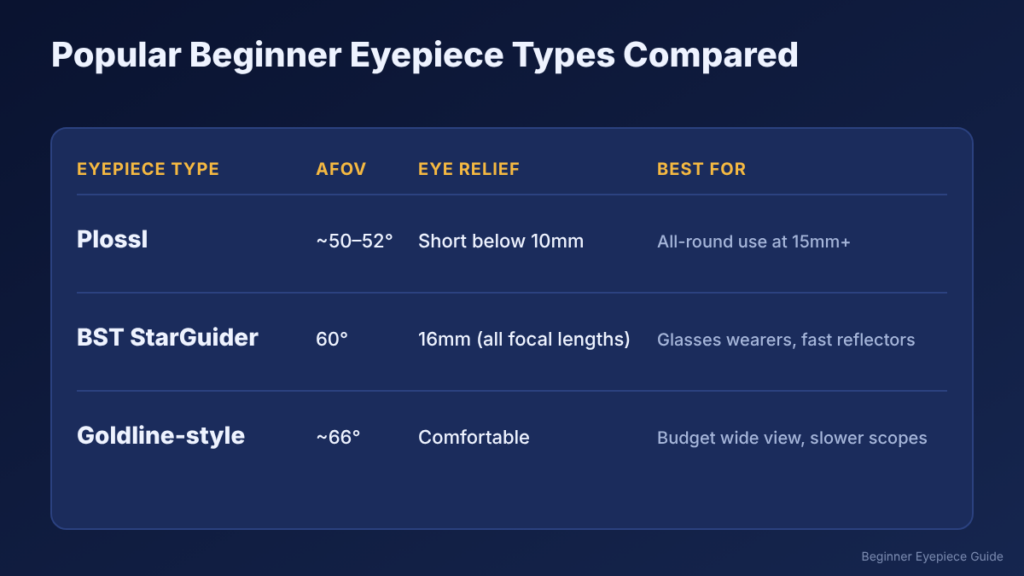
The Plossl is the classic beginner eyepiece and the backbone of most eyepiece kits. It offers sharp images, a roughly 50–52° field and low cost. Plossls are excellent at 15mm and above. Below about 10mm, their eye relief becomes uncomfortably short.
BST StarGuider
The BST StarGuider is one of the most popular upgrades for beginners. It has a 60° field, a consistent 16mm eye relief across all focal lengths (great for glasses wearers) and good sharpness, even in fast reflectors. It’s sold in a range of focal lengths, so you can build a full set from one series.
“Goldline” Style Eyepieces
Goldline-type eyepieces offer a wider, roughly 66° field and comfortable eye relief at a budget price. They’re good value at medium and high power in slower telescopes. In fast reflectors, expect some softness toward the edge of the field.
Should You Buy an Eyepiece Kit or Build Your Own Set?
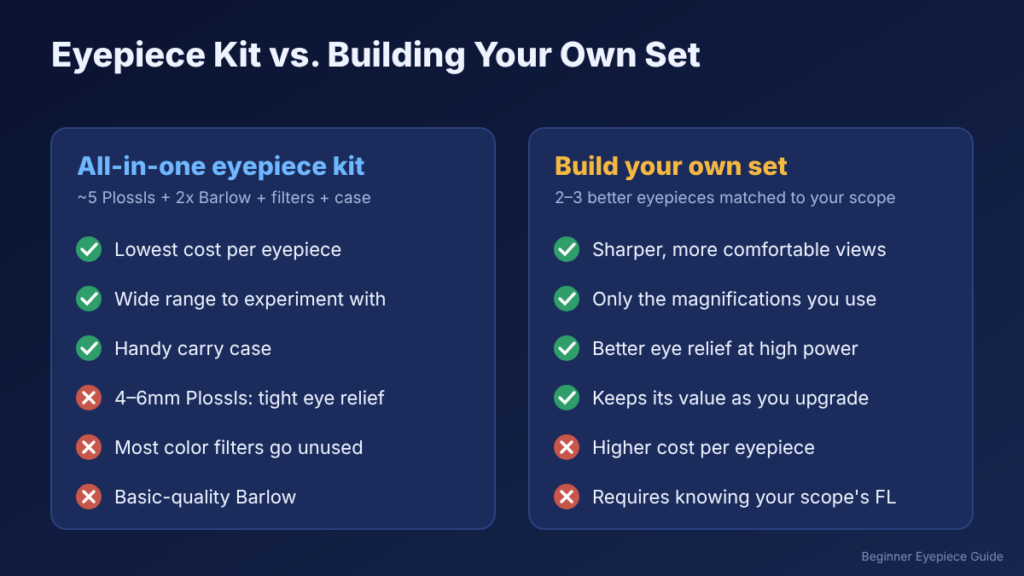
All-in-one eyepiece kits (such as the Celestron 1.25″ Eyepiece and Filter Kit or similar SVBONY kits) typically include five Plossls, a 2x Barlow, colored filters and a carry case.
- Pros: low cost per piece, a wide range of magnifications, convenient storage
- Cons: the shortest focal lengths are hard to use because of tight eye relief, the colored filters see little use (a Moon filter is the most useful one), and the Barlow is usually basic
Building your own set of 2–3 better eyepieces costs about the same as a kit, or a bit more. You get more comfortable, sharper views at the magnifications you’ll actually use.
Our recommendation: if your budget is tight or you’re not sure what you’ll enjoy observing, a kit is a fine way to experiment. If you already know you’re committed, three quality eyepieces matched to your telescope will serve you better and longer.
Recommended Beginner Eyepiece Sets by Telescope
| Telescope (example) | Low power | Medium power | High power |
|---|---|---|---|
| 70mm f/10 refractor (700mm FL) | 25mm (28x) | 12mm (58x) | 6mm (117x) |
| 130mm f/5 reflector (650mm FL) | 25mm (26x) | 10mm (65x) | 5mm (130x) |
| 8″ f/6 Dobsonian (1200mm FL) | 25–32mm (38–48x) | 12–15mm (80–100x) | 6–8mm (150–200x) |
| 8″ f/10 SCT (2032mm FL) | 32–40mm (51–64x) | 15–20mm (102–135x) | 9–10mm (203–226x) |
Don’t see your telescope? Check its focal length and focal ratio (usually printed on the tube), then use the exit pupil guide above: about 5mm for low power, 2mm for medium and 1mm for high.
Get More From Your Set With a Barlow Lens
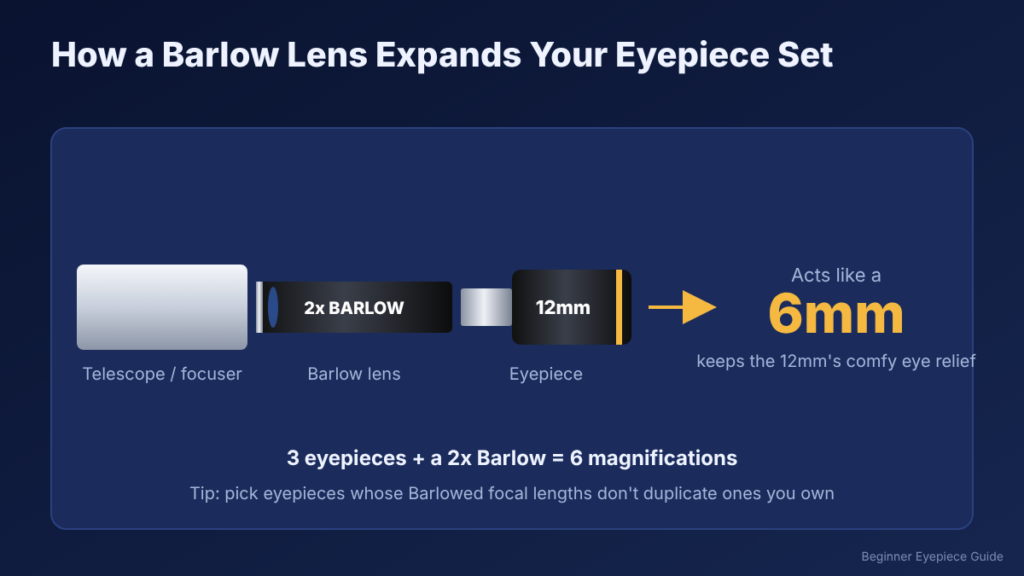
A Barlow lens fits between the focuser and the eyepiece and multiplies magnification, usually by 2x or 3x. With one Barlow, a three-eyepiece set effectively becomes six magnifications.
Avoid duplicates: pick eyepieces whose “Barlowed” focal lengths don’t overlap with ones you already own. For example, a 12mm eyepiece with a 2x Barlow acts like a 6mm, so you wouldn’t also need a 6mm. A big bonus is that a Barlow keeps the longer eyepiece’s more comfortable eye relief, which makes it a good alternative to very short Plossls.
Quality matters. A good achromatic or ED Barlow keeps images sharp, while very cheap ones can add blur and dim the view.
How to Care for Your Eyepieces
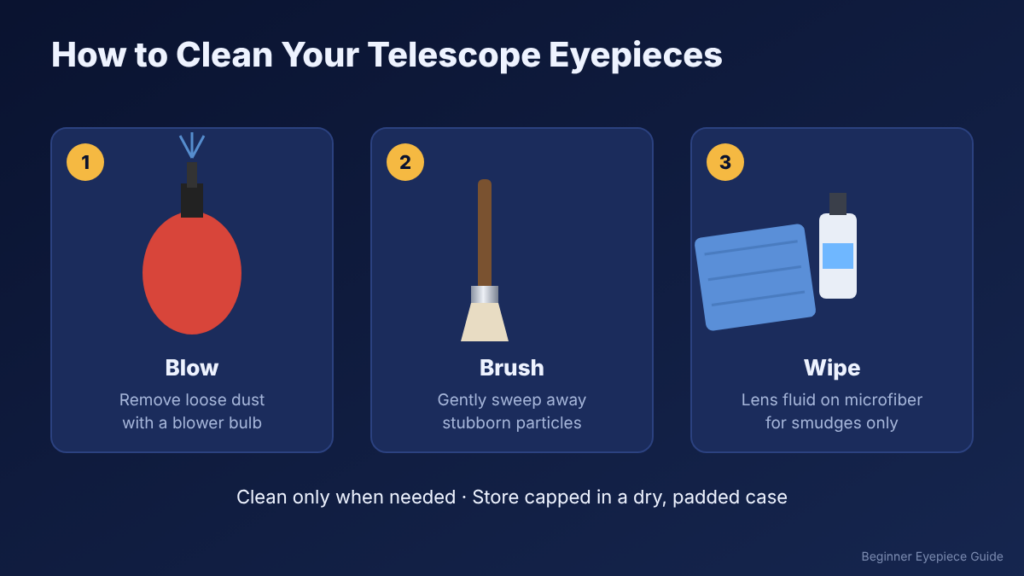
- Clean only when needed. Tiny dust specks don’t noticeably affect the view, and frequent cleaning risks scratching the coatings. Fingerprints, skin oils and smudges are what actually reduce image quality.
- Use the right tools, in order: a blower bulb first, then a soft lens brush, then a small amount of lens cleaning fluid or isopropyl alcohol on a lens tissue or microfiber cloth for smudges. Explore Scientific’s cleaning guide walks through each step.
- Store them dry and ventilated. Keep eyepieces capped and upright in a padded case in a cool, dry place, ideally with a silica gel pack. Avoid airtight cases, which can trap moisture. After a dewy night, let eyepieces dry completely before packing them away, because lingering moisture can lead to fungus.
Tips for New Stargazers
- Start with three eyepieces. Learn what each magnification is good for before buying more.
- Use low power first. Always find and center an object with your longest eyepiece, then switch to higher power.
- Try before you buy. Local astronomy clubs and star parties are a great way to look through different eyepieces before spending money.
- Match your eyepieces to the sky. On nights with steady air, push the magnification. On turbulent nights, stay at medium power.
Frequently Asked Questions
What is the best eyepiece set for telescope beginners?
The best beginner eyepiece set covers low, medium and high magnification, typically around 25mm, 12–15mm and 6–8mm, depending on your telescope’s focal length. Budget kits with Plossl eyepieces are a good entry point. Series like the BST StarGuider offer a comfortable, sharper upgrade.
How many eyepieces does a beginner need?
Three is ideal: one each for low, medium and high power. Adding a 2x Barlow lens effectively doubles your range of magnifications.
Are telescope eyepiece kits worth it?
Kits are good value for experimenting, but the shortest eyepieces often have uncomfortable eye relief and most of the colored filters go unused. If you know which magnifications you need, buying 2–3 better eyepieces individually usually gives a better experience.
Will any eyepiece fit my telescope?
Most telescopes accept standard 1.25-inch eyepieces, and many also accept 2-inch. Check your focuser size before buying. A few very low-cost telescopes use 0.965-inch eyepieces, which aren’t interchangeable without an adapter or upgraded diagonal.
What eyepiece is best for viewing planets?
Use an eyepiece that gives an exit pupil of about 0.5–1mm, usually 5–8mm in most beginner telescopes. Comfortable eye relief and good sharpness matter more than a wide field for planetary viewing. Aperture and focal length matter too. Our guide to the best telescope for planetary imaging and observation covers which scopes show the most planetary detail.
What magnification do I need to see Saturn’s rings?
Saturn’s rings are visible at around 25–50x. About 100–150x shows them clearly, plus the Cassini Division on steady nights with a 4-inch or larger telescope.
Conclusion: Choosing Your Beginner Eyepiece Set
The best eyepiece set for telescope beginners isn’t the biggest kit or the highest magnification. It’s a small, well-chosen range of focal lengths matched to your telescope. Start with low, medium and high power eyepieces with comfortable eye relief, add a Barlow if you want more range, and expand your collection as you learn what you love to observe. If you eventually want to capture what you see, our guide on what you need for astrophotography is the natural next step.
One Response