
The Passion Pick is reader-supported. When you buy through links on this page, we may earn a commission at no extra cost to you. As an Amazon Associate, we earn from qualifying purchases.
The best starter telescope for most beginners is an 8-inch Dobsonian, like the Apertura AD8 at about $650. It gathers enough light for Saturn’s rings, Jupiter’s cloud belts and hundreds of galaxies, and you aim it by pushing the tube. On a tighter budget or with less space, the $309 Sky-Watcher Heritage 150 sits on a table. If you don’t know the sky yet, a phone-guided Celestron StarSense model points the way.
Ask the same question in an astronomy forum and you’ll hear the same three answers. Buy the biggest aperture you can carry and store, put it on a mount that doesn’t shake, and ignore magnification claims on the box. AstroBackyard recommends an 8-inch Dobsonian for that reason, and every pick below follows those rules.
These picks come from specs, manufacturer information and published reviews. We haven’t tested them hands-on.
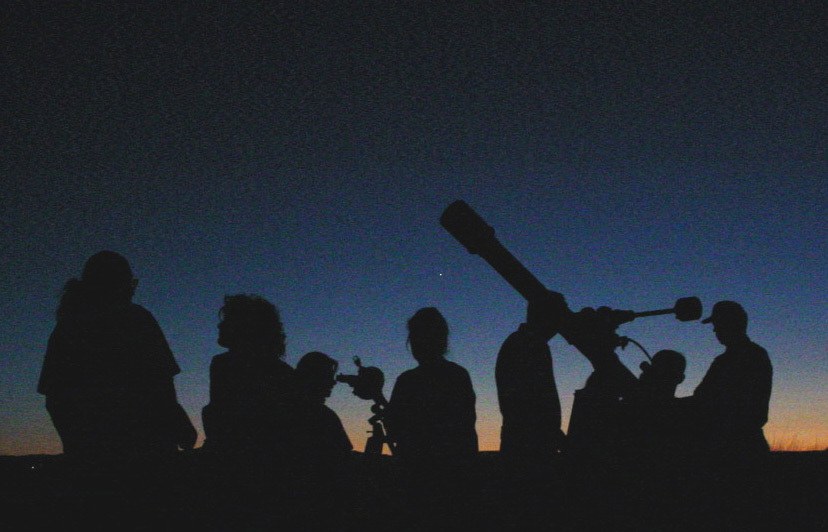
Best starter telescopes at a glance
1. Apertura AD8 Dobsonian (best overall)
Specs: 8-inch (203 mm) mirror, 1200 mm focal length (f/5.9), 30 mm (40x) and 9 mm (133x) eyepieces, 8×50 right-angle finder. It comes with a mirror cooling fan, a Moon filter and a laser collimator. Weight is 52 pounds in two pieces: a 24.5-pound tube and a 27.7-pound base.
Who it’s for: adults and families who want one telescope that will keep showing new things for years, and who have a closet or garage corner to store it.
What you’ll see: Saturn’s rings and its largest moon, Jupiter’s cloud belts, the Orion Nebula, globular clusters breaking into stars, and galaxies like Andromeda and Bode’s Galaxy.
Watch out for: the 46-inch tube is bulky in a small car, and each half is a real lift. A Dobsonian also needs its mirrors lined up now and then. The included laser collimator makes that a five-minute job.
The AD8 is AstroBackyard’s top choice for a first telescope, and it ships with more accessories than most 8-inch Dobsonians. For larger options, see our best Dobsonian telescope guide.
2. Sky-Watcher Heritage 150 (best compact and budget)
Specs: 150 mm (6-inch) mirror, 750 mm focal length (f/5), 25 mm (30x) and 10 mm (75x) eyepieces, red dot finder. The tube collapses from 48 to under 17 inches; it weighs 8 pounds and the base 15.5.
Who it’s for: apartment dwellers and anyone who wants a big mirror they can carry out in one trip. Set it on a sturdy table, a cooler or a camp stool.
Watch out for: you need something stable to set it on, and the open truss tube can pick up stray light near streetlights.
The Heritage 150 gives you three-quarters of the AD8’s aperture at half the price and half the weight.
3. Celestron StarSense Explorer DX 130AZ (easiest to find targets)
Specs: 130 mm parabolic mirror, 650 mm focal length (f/5), 25 mm (26x) and 10 mm (65x) eyepieces, alt-azimuth tripod with slow-motion controls, built-in phone dock. Total weight is 18 pounds, with a 2-year warranty.
How it works: after a two-minute setup, the StarSense app uses your phone’s camera to read the stars overhead and lists what’s visible tonight. On-screen arrows guide you, and the bullseye turns green when the object is in view. No motors or batteries are needed.
Who it’s for: beginners who don’t know the constellations and don’t want to learn them before seeing anything.
Watch out for: the app needs a recent phone (Celestron lists iOS 18+ and Android 12+), so check Celestron’s compatibility tool first. Keep the phone charged; Celestron suggests a power bank.
The StarSense Explorer DX 130AZ costs more than a manual 130 mm scope. The extra buys you a target list and a guide to each one.
4. Celestron StarSense Explorer LT 80AZ (best under $250)
Specs: 80 mm lens, 900 mm focal length (f/11), 25 mm (36x) and 10 mm (90x) eyepieces plus a 2x Barlow, erect-image diagonal, full-height tripod. It weighs 9.2 pounds.
Who it’s for: first-timers on a budget who want app guidance and a scope light enough to carry with one hand. The erect-image diagonal also makes it a decent daytime spotting scope.
Watch out for: 80 mm shows the Moon, planets and bright clusters well, but faint galaxies stay dim. Skip the Barlow on the 10 mm eyepiece; 180x is past what this lens can show clearly.
The StarSense Explorer LT 80AZ is the cheapest way into Celestron’s app-guided system.
5. Celestron AstroMaster 102AZ (best grab-and-go refractor)
Specs: 102 mm (4-inch) lens, 660 mm focal length (f/6.5), 20 mm (33x) and 10 mm (66x) eyepieces, erect-image diagonal, manual alt-azimuth tripod. It weighs 12.9 pounds.
Who it’s for: people who want to set up in under a minute on a balcony or at a campsite. Refractors need no mirror alignment and no cool-down time.
Watch out for: a fast refractor at this price shows some purple fringing around bright planets and the Moon’s edge. The tripod is fine at low power but softer at high power.
The AstroMaster 102AZ is the simplest scope on this list to set up and pack away.
6. ZWO Seestar S30 Pro (best for photos)
Specs: 30 mm apochromatic lens, 4K camera plus a wide-angle camera, built-in light-pollution filter, motorized GoTo mount, magnetic solar filter. It weighs 3.6 pounds, and the battery lasts about 6 hours.
Who it’s for: beginners who care more about color photos of nebulas and galaxies than looking through an eyepiece, especially from bright suburbs. You pick a target in the app, and the Seestar finds it and builds up the image on your phone.
Watch out for: you look at a screen, not through glass. Planets come out small because the lens is only 30 mm.
The Seestar S30 Pro is the easiest step toward the hobby we cover in what you need for astrophotography.
How to choose your first telescope
Aperture first
Aperture is the width of the main mirror or lens, and it decides how bright and sharp everything looks. The Planetary Society calls it more important than magnification and suggests 4 to 5 inches as a good start. An 8-inch mirror gathers about 2.5 times the light of a 5-inch.
Pick the type that fits how you’ll use it
| Type | How it works | Best for | On this list |
|---|---|---|---|
| Reflector (Dobsonian) | A curved mirror gathers light | The most aperture per dollar; faint galaxies and nebulas | AD8, Heritage 150, StarSense DX 130AZ |
| Refractor | A lens at the front | Quick setup, no maintenance, daytime use | StarSense LT 80AZ, AstroMaster 102AZ |
| Catadioptric (Maksutov, Schmidt-Cassegrain) | A mirror plus a lens, in a short tube | Planets and the Moon in a compact package | None at this price |
| Smart telescope | A small lens, a camera and motors | Photos from bright suburbs, zero sky knowledge | Seestar S30 Pro |
Choose a simple mount
The Planetary Society suggests beginners use an alt-azimuth mount, which moves up-down and left-right, and skip equatorial mounts. A Dobsonian base is the simplest alt-azimuth design there is. Sky & Telescope calls low-quality mounts the most common problem with budget telescopes, so a solid base matters more than extras.
Ignore magnification claims
A practical ceiling is about 50x per inch of aperture, according to Sky & Telescope, and the Planetary Society says more than 200x has little benefit for a beginner scope. A box that promises “500x” on a 70 mm telescope is a warning sign.
How much is a good starter telescope?
- $200–$300: a real first telescope, like the StarSense LT 80AZ or Heritage 150. Below about $150, most scopes have shaky mounts.
- $350–$650: the sweet spot. An 8-inch Dobsonian, an app-guided 130 mm, or a 4-inch refractor.
- $650 and up: smart telescopes and larger Dobsonians. Spend this only once you know the hobby sticks, unless photos are the goal from day one.
What can you see with a starter telescope?
The Moon’s craters and mountains look stunning in every scope here, best near the shadow line a few days either side of first quarter. Jupiter shows its four largest moons and, in 4 inches and up, its cloud belts. Bright star clusters, the Orion Nebula and the Andromeda Galaxy are easy first deep-sky targets.
What size telescope do you need to see Saturn’s rings? Any telescope on this list. Even a 70–80 mm scope at about 25x to 50x shows the rings clearly as a loop around the planet. A 6- or 8-inch scope adds the Cassini Division (the dark gap in the rings) on steady nights.
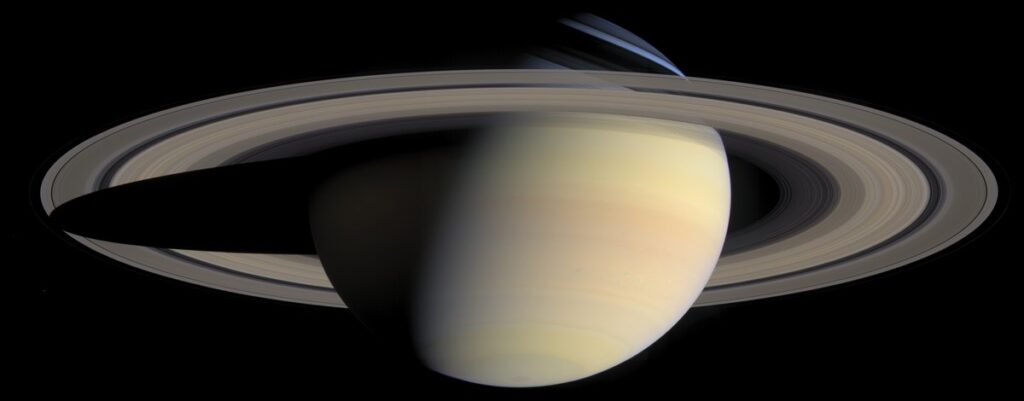
Set expectations: Saturn looks like a small, sharp ringed ball, not the giant color image below. Galaxies look like soft gray glows. A smart telescope is the exception, because it builds up color over several minutes on a screen.
Does light pollution matter?
The Moon, planets and bright clusters look fine from a backyard in town. Faint galaxies and nebulas need darker skies, so plan a trip out of town for those. The Seestar’s light-pollution filter and image stacking make it the best choice here for bright suburbs.
Your first-night kit
- A red flashlight: it keeps your night vision, which takes about 20–30 minutes to build up.
- A star chart or app: a planisphere (a rotating star map) or a free sky app shows what’s up tonight.
- One mid-power eyepiece: around 15 mm fills the gap between most kits’ two eyepieces. See our best eyepiece set for telescope beginners.
- A chair: a comfortable seat makes it easier to spot detail at the eyepiece.
- Time to cool down: set the telescope outside 30 minutes before you observe so the mirror or lens matches the air temperature.
For a safe start, never point any of these telescopes at the Sun without a proper front-mounted solar filter.
Starter telescope FAQ
What is a good first telescope for a beginner?
An 8-inch Dobsonian like the Apertura AD8 for most people. It has the most aperture for the money and the simplest mount. Choose the Heritage 150 if space or budget is tight.
What is the best basic telescope for beginners?
The Sky-Watcher Heritage 150. It’s a manual tabletop Dobsonian with no electronics, sets up in a minute and costs about $309.
What size telescope is needed to see Saturn’s rings?
About 70 mm or larger, at 25x to 50x. Every telescope on this list shows them.
How much is a good starter telescope?
$250 to $650 buys an excellent first telescope. Under about $150, most have shaky mounts and plastic parts.
Is a Dobsonian good for beginners?
Yes. You point it by pushing the tube, with no alignment, and it gives the most aperture per dollar. The trade-off is size: an 8-inch Dob weighs about 50 pounds in two parts.
Should I buy a refractor or a reflector?
A reflector if you want to see faint galaxies and nebulas for the money. A refractor if you want fast setup, no maintenance and daytime use.
Can I take pictures with a starter telescope?
You can photograph the Moon by holding a phone to the eyepiece of any scope here. For nebulas and galaxies, a smart telescope like the Seestar S30 Pro is the easiest start.
Keep exploring
- More stargazing guides in our Sky hub
- Focused on planets: best telescope for planetary imaging and observation
- Ready for photos: what is the best camera for astrophotography