
The Passion Pick is reader-supported. When you buy through links on this page, we may earn a commission at no extra cost to you. As an Amazon Associate, we earn from qualifying purchases.
The best telescope for kids is a small, sturdy reflector on a tabletop base, like the Sky-Watcher Heritage 130. It’s easy to aim and shows Saturn’s rings and the Moon’s craters, and it costs around $300. For kids under 8, start with the $75 Celestron FirstScope 76. Teens ready for more can step up to a 6-inch Dobsonian.
Aperture (the width of the main mirror or lens) and a steady mount matter far more than magnification. Sky & Telescope puts it plainly: low-quality mounts are the most common problem with budget telescopes. Every pick below has a mount that holds still, so a child can stay with a target long enough to enjoy it.
These picks come from specs, manufacturer information and published reviews. We haven’t tested them hands-on. Prices and stock were checked on November 16, 2026.
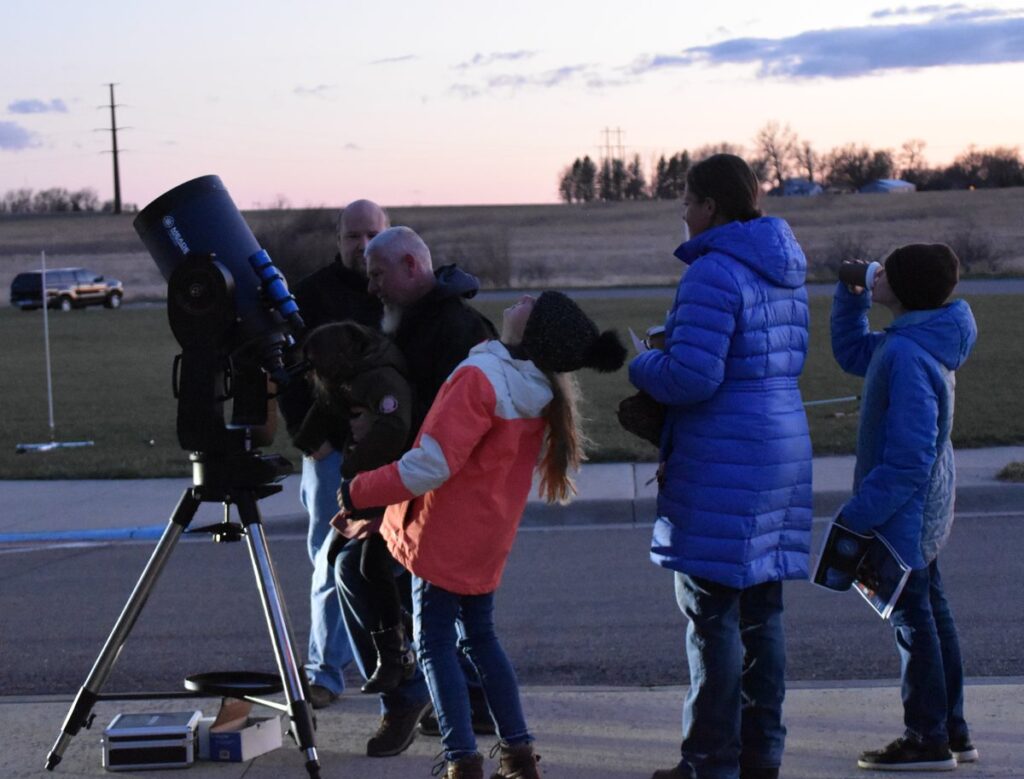
Best telescopes for kids at a glance
1. Sky-Watcher Heritage 130 (best overall)
Specs: 130 mm (5.1-inch) mirror, 650 mm focal length (f/5), 25 mm (26x) and 10 mm (65x) eyepieces, red dot finder. The tube collapses from 25 inches to under 15, and the scope weighs about 20 pounds with its base.
Who it’s for: kids 8 and up who’ll observe from a picnic table, a sturdy stool or a deck rail. It’s also the one to buy if the whole family will share it.
What kids will see: the Moon’s craters and mountains, Saturn’s rings, Jupiter’s cloud belts and its four largest moons, and bright clusters and nebulas like the Pleiades and the Orion Nebula.
Watch out for: it needs a stable surface at a comfortable height, so check you have one before you buy. Like every reflector, its mirrors need lining up (collimation) now and then, which takes a few minutes once you’ve learned how.
The Heritage 130 gives you the most light-gathering for the money on this list. That’s why it beats scopes that cost twice as much.
2. Celestron FirstScope 76 (best budget for young kids)
Specs: 76 mm mirror, 300 mm focal length, 20 mm (15x) and 4 mm (75x) eyepieces. It weighs 4.3 pounds and arrives assembled.
Who it’s for: 5- to 8-year-olds sharing the scope with an adult. It’s a low-cost way to find out whether the interest sticks.
What kids will see: the Moon in sharp detail, Jupiter’s moons as tiny points of light, and bright star clusters.
Watch out for: there’s no finder, so you aim by sighting along the tube. The 4 mm eyepiece gives a dim, fiddly view, so most of the fun happens at 15x. A mid-range eyepiece from our eyepiece set guide is a cheap upgrade. Stock comes and goes, and one major retailer had it back-ordered in November 2026.
The FirstScope is the cheapest real telescope we’d recommend. It isn’t a toy, though, so set it up together.
3. Celestron StarSense Explorer 114 (easiest to find targets)
Specs: 114 mm parabolic mirror, 450 mm focal length (f/4), 17 mm (26x) and 10 mm (45x) eyepieces, built-in smartphone dock. It weighs 12.6 pounds.
How the app works: you put your phone in the dock and open the StarSense app. It reads the star patterns overhead, then shows arrows to push the scope toward your target. When the bullseye turns green, the object is in view. There are no motors and no alignment steps.
Who it’s for: kids 8 to 12 who’d lose interest hunting for things, and families who don’t know the night sky yet.
Watch out for: it needs a compatible phone, so check Celestron’s list first. A bright phone screen also spoils dark-adapted eyes, so turn the brightness down.
The StarSense Explorer 114 costs more than the Heritage 130 and has a slightly smaller mirror. You’re paying for a child finding Saturn on their own on night one.
4. Celestron AstroMaster 70AZ (sky and daytime nature)
Specs: 70 mm lens, 900 mm focal length (f/13), 20 mm (45x) and 10 mm (90x) eyepieces, erect-image diagonal, full-height tripod. It weighs 10.8 pounds.
Who it’s for: kids 9 and up who’d rather stand at a tripod. It also suits families who want one scope for the Moon at night and birds or wildlife by day. The erect-image diagonal shows land views right side up.
What kids will see: crisp views of the Moon, Saturn’s rings as a small, sharp oval, and Jupiter’s moons.
Watch out for: with a 70 mm lens, galaxies and nebulas look faint, and curious kids may outgrow it in a year or two. Never point it at the Sun during daytime use (see the safety section below).
The AstroMaster 70AZ pairs well with our guide to binoculars for bird watching if your kids love both sky and nature.
5. Apertura AD6 Dobsonian (best for teens)
Specs: 6-inch (152 mm) mirror, 1200 mm focal length (f/7.9), 25 mm (48x) and 9 mm (133x) Plössl eyepieces, 6×30 right-angle finder. It weighs 42.9 pounds in two pieces, and the tube is 45 inches long.
Who it’s for: teens 12 and up who’ve caught the bug, or a family ready for a scope that will last for years.
What kids will see: more detail on Jupiter and Saturn, globular clusters starting to break into stars, and galaxies like Andromeda as a glowing smudge.
Watch out for: an adult will need to carry the tube and base outside. It also takes floor space indoors.
The AD6 sits on the ground and swings smoothly in any direction. For larger models, see our best Dobsonian telescope guide.
6. ZWO Seestar S30 Pro (for tech-loving kids)
Specs: 30 mm f/5.3 apochromatic lens (160 mm focal length), 4K camera plus a wide-angle camera, built-in light-pollution filter, motorized GoTo mount, magnetic solar filter included. It weighs 3.6 pounds, and the battery lasts about 6 hours.
Who it’s for: kids 8 and up who love gadgets and taking pictures, and families in light-polluted towns. It finds targets by itself, then builds up a color image of a nebula or galaxy on a phone or tablet over a few minutes.
Watch out for: kids look at a screen, not through an eyepiece. Planets look small because the lens is only 30 mm. It’s the priciest pick here.
The Seestar S30 Pro is a smart telescope, a good next step toward the hobby in what you need for astrophotography.
How to choose a telescope for kids
Match the telescope to the child’s age
| Age | What works | Why |
|---|---|---|
| 5–7 | A light tabletop reflector, used with an adult | Short attention spans and small hands: it needs to be ready in a minute and aim simply |
| 8–12 | A 114–130 mm tabletop Dobsonian, or one with app guidance | Big enough to show Saturn’s rings and nebulas, small enough to carry alone |
| 13+ | A 6-inch Dobsonian or a smart telescope | Teens can handle heavier gear and want more targets or photos |
Aperture beats magnification
Aperture decides how bright and sharp everything looks. The Planetary Society calls it more important than magnification and suggests 4 to 5 inches as a good start. That’s the 114–130 mm range of picks 1 and 3.
Ignore boxes that brag about “500x” or “675x”. A practical ceiling is about 50x per inch of aperture, according to Sky & Telescope, and less on most nights. A 70 mm (2.75-inch) scope tops out around 140x. Past that, the image just gets dimmer and blurrier.
Pick a mount a child can use
- Tabletop Dobsonian: push the tube where you want it to go. It’s the simplest mount there is, and it’s why picks 1, 2 and 3 are all this design.
- Alt-azimuth tripod: moves up-down and left-right like a camera tripod. Easy to learn, but cheap tripods shake.
- Equatorial mount: tracks the sky’s motion once it’s lined up on the North Star. The Planetary Society suggests beginners skip it, because the setup confuses many adults too.
- GoTo or smart mount: motors find and follow targets for you. Kids skip learning the sky, but they’ll see more on night one.
Skip the toy telescopes
Watch for thin plastic tripods, plastic lenses and “power” numbers in big type on the box. A telescope that wobbles every time a child touches the eyepiece gets put in a closet. If the budget is under $75, a good pair of 10×50 binoculars will show the Moon and star clusters better than a toy scope.
What can kids see through a telescope?
Start with the Moon. Aim at the line between light and shadow, a few days either side of first quarter. Craters there cast long shadows and look almost 3D, even at low power. After that:
- Jupiter: four moons in a line beside it, which shift position from night to night. Larger scopes show its cloud belts.
- Saturn: the rings are visible in every pick on this list, even at about 45x.
- The Pleiades and the Orion Nebula: easy winter targets that look best at the lowest power.
- Double stars: Albireo in summer looks like a gold and blue pair.
Planets look small, so set expectations. Saturn looks like a tiny, perfect ringed ball, not the giant one in NASA photos. Most kids are thrilled anyway, because they found it themselves.
Winter is a good season to start: it gets dark early enough to observe before bedtime.
[Photo: NASA visualization of the first-quarter Moon, with craters sharp along the shadow line. Alt text: “First-quarter Moon with craters along the shadow line, the best first target for a telescope for kids”. File: first-quarter-moon-telescope-for-kids.jpg ]
Telescope safety: never point it at the Sun
Looking at the Sun through a telescope can blind a child in an instant. Teach this rule before the first night out, and never leave a telescope unattended in daylight where a curious child could look through it.
The American Astronomical Society says a solar filter must be attached securely to the front of a telescope. Never look through a telescope while wearing eclipse glasses, because concentrated sunlight can burn through them. The Seestar S30 Pro comes with a magnetic front solar filter. For the others, buy a filter made to fit that exact scope.
Try a telescope before you buy
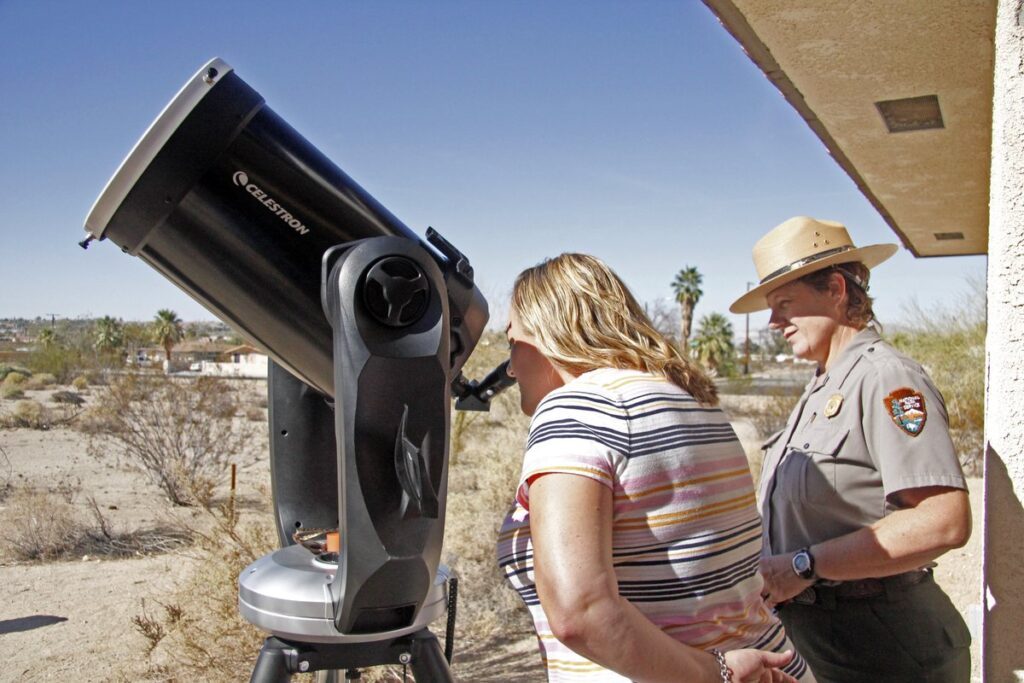
Many national parks run free stargazing programs where rangers and volunteers set up telescopes for visitors. Local astronomy clubs hold public star parties, and NASA’s Night Sky Network lists clubs and events across the US. A night at one of these lets your child look through several kinds of telescopes before you spend anything.
Telescope for kids FAQ
What age is right for a first telescope?
Around 5 with an adult doing the aiming, and around 8 for a child to use one alone. A tabletop model like the FirstScope 76 or the Heritage 130 suits those ages best.
What is the best telescope for a 10-year-old?
The Sky-Watcher Heritage 130 for most 10-year-olds. Choose the StarSense Explorer 114 if they’d rather have an app point the way.
What magnification do kids need to see Saturn’s rings?
About 25x to 50x shows the rings as a clear loop. Every pick on this list reaches that with its included eyepieces.
Is a refractor or a reflector better for kids?
For the money, a reflector gathers more light, so it shows more. A refractor needs no mirror alignment and shows daytime views right side up, which helps if you’ll use it for nature too.
How much should I spend on a kids’ telescope?
Between $75 and $300 covers excellent first scopes. Below $75, buy binoculars instead.
Can a kids’ telescope see galaxies?
Yes, under dark skies. Andromeda shows up as a soft glowing smudge in a 114–152 mm scope. A smart telescope can build up a color photo of it.
What are good space gifts for kids besides a telescope?
Binoculars, a planisphere (a rotating star map), a red flashlight that keeps night vision, and a beginner astronomy book make a great first kit.
Keep exploring
- More stargazing guides in our Sky hub
- Older kids into planets: best telescope for planetary imaging and observation
- More screen-free ideas: what are the best hobbies for kids and 44 family hobbies to enjoy with kids of every age
- Curious about the very small instead? Try these microscope activities for middle school kids
One Response