
The Passion Pick is reader-supported. When you buy through links on this page, we may earn a commission at no extra cost to you. As an Amazon Associate, we earn from qualifying purchases.
The best binoculars for kids are light, low-power real binoculars, around 6x to 8x, with eyepieces that fold close enough together for a small face. For most kids aged 5 to 12, that means the Vortex Bantam HD 6.5×32 at about $70. Preschoolers do fine with a $30–$50 pair like the National Geographic 6×21. Teens can move up to a full-size 8×30.
Low magnification matters more for kids than for adults. Audubon calls it “more forgiving in unsteady hands”, and it gives a wider view, so a child can find the bird before it flies.
These picks come from specs, manufacturer information and published reviews. We haven’t tested them hands-on. Prices and stock were checked on November 16, 2026.
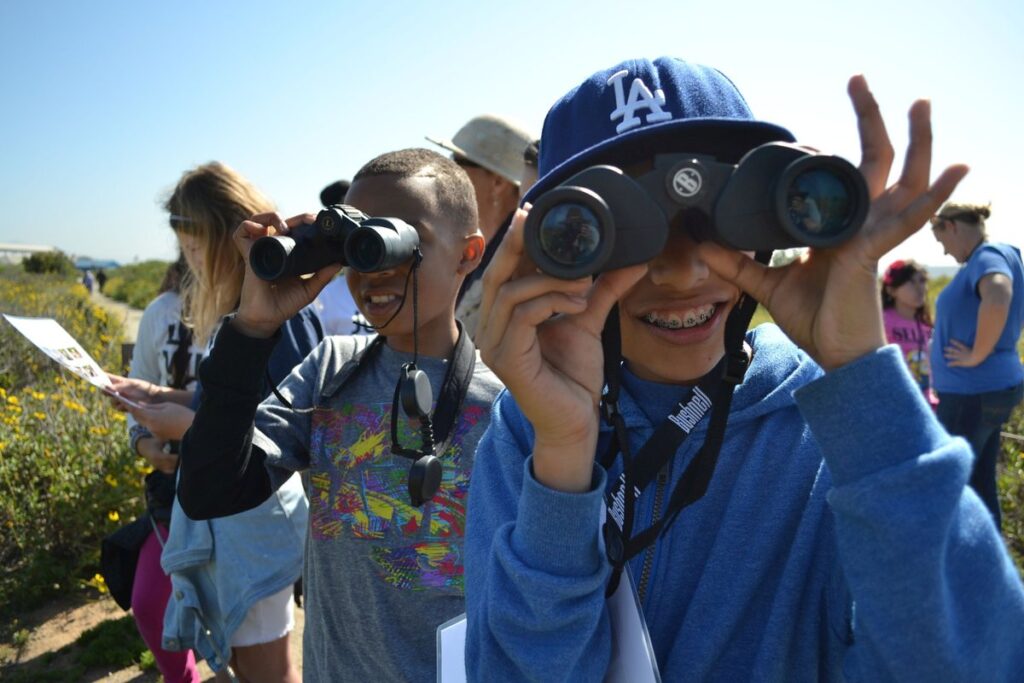
Best binoculars for kids at a glance
1. Vortex Bantam HD 6.5×32 (best overall, ages 5–12)
Specs: 6.5x magnification, 32 mm lenses, 14.4 oz, 400 ft field of view at 1,000 yards, focuses down to 12 ft. Eyepieces fold to 51 mm apart. Waterproof, with Vortex’s lifetime VIP warranty.
Who it’s for: most kids from kindergarten to middle school. It’s built for small hands and narrow faces but uses real optics, so it won’t feel like a toy at age 11.
Watch out for: at 14 oz it’s heavier than a plastic toy pair, so younger kids will want a neck strap on. That’s included.
The Bantam HD is about $70 at major US outdoor retailers. The warranty covers drops, which matters with kids.
2. National Geographic 6×21 (best budget for little kids, ages 4–7)
Specs: 6x magnification, 21 mm lenses, 5.9 oz (167 g), bright-colored rubber body. Not waterproof.
Who it’s for: preschoolers and early grade-schoolers who need something light enough to hold up for more than a few seconds.
Watch out for: the small lenses get dim at dusk and in deep shade. It’s also not waterproof, so bring it in from the rain. Space.com’s review calls it a big step up from toy binoculars, but daytime-only.
The National Geographic 6×21 sells for about $30–$50, a good price to test whether the interest sticks.
3. Celestron Outland X 8×25 (best compact for older kids, ages 9+)
Specs: 8x magnification, 25 mm lenses, about 11 oz, 429 ft field of view at 1,000 yards. Eyepieces fold to 56 mm. Waterproof and fogproof, with a 2-year warranty.
Who it’s for: older kids who want a pocket-size pair for hikes and camp. Audubon’s young testers found its wide view and easy focus wheel comfortable.
Watch out for: 56 mm may be too wide for many children under about 9. Do the fit check below before you buy. Its 10 mm eye relief is short for kids who wear glasses. One major retailer had it back-ordered in November 2026.
The Outland X costs about $65–$70.
4. Kowa YF II 6×30 (best to grow into, ages 6–14)
Specs: 6x magnification, 30 mm lenses, 16.5 oz, 420 ft field of view at 1,000 yards, focuses to 16.4 ft. Eyepieces fold to 50 mm, the narrowest on this list. Generous 20 mm eye relief, waterproof, limited lifetime warranty through US and Canadian dealers.
Who it’s for: a child who’s serious about birds and will keep the same pair for years. The bigger lenses give a brighter view than compacts.
Watch out for: at just over a pound, it’s best for kids old enough to hold it steady.
The Kowa YF II 6×30 is about $120.
5. Nikon Prostaff P3 8×30 (best for teens, ages 11+)
Specs: 8x magnification, 30 mm lenses, 16.8 oz, 456 ft field of view at 1,000 yards (the widest here), focuses down to 8.2 ft. Eyepieces fold to 56 mm. Waterproof to 1 meter for 10 minutes.
Who it’s for: teens, or a family that wants one pair adults and older kids can share. The close focus is great for butterflies and dragonflies.
Watch out for: Audubon’s testers found it heavier for younger kids, and it won’t fit narrow faces.
The Prostaff P3 8×30 lists at about $150 and is often on sale nearer $90.
6. Celestron Cometron 7×50 (best for stargazing, ages 12+)
Specs: 7x magnification, big 50 mm lenses, 27.3 oz, 6.6° field of view. Eyepieces fold to 56 mm.
Who it’s for: older kids who love the night sky. The big lenses gather light for the Moon, star clusters and the Milky Way, and cost far less than a telescope.
Watch out for: at 27 oz it’s heavy, so brace your elbows or lie back in a reclining chair. It focuses no closer than 26 ft, so it’s a poor choice for birds at the feeder.
The Cometron 7×50 lists at $47.95. It was sold out on Celestron’s site in November 2026 but in stock at other retailers. Ready for more? See our guide to the best telescope for kids
How to choose binoculars for kids
What magnification is best for kids?
Pick 6x to 8x. The Cornell Lab’s K-12 team recommends 7x or 8x with lenses between 25 and 40 mm, and 6x is even easier for younger kids. Higher power shrinks the view and magnifies every wobble, so the bird is gone before a child finds it.
| Age | Magnification | Lens size | Weight to aim for |
|---|---|---|---|
| 4–6 | 6x | 21–25 mm | Under 8 oz |
| 7–10 | 6x–8x | 25–32 mm | Under 15 oz |
| 11+ | 8x | 30–42 mm | Up to about 1.5 lb |
A rough guide based on the Cornell and Audubon advice above. Stronger, bigger kids can go heavier.
Check the eyepiece spacing (the fit test)
This is the most-missed detail. Children’s eyes sit closer together than adults’, and many adult binoculars won’t fold narrow enough. When that happens, a child sees two circles or a black edge and gives up. Check the spec called interpupillary distance (IPD) and look for a minimum around 50–52 mm for kids under 9. The Bantam (51 mm) and the Kowa (50 mm) qualify; the Outland X, Prostaff and Cometron (56 mm) suit older kids.
To test a pair, follow Audubon’s method: start with the barrels far apart and have your child slowly push them together until they see one clear circle with no black.
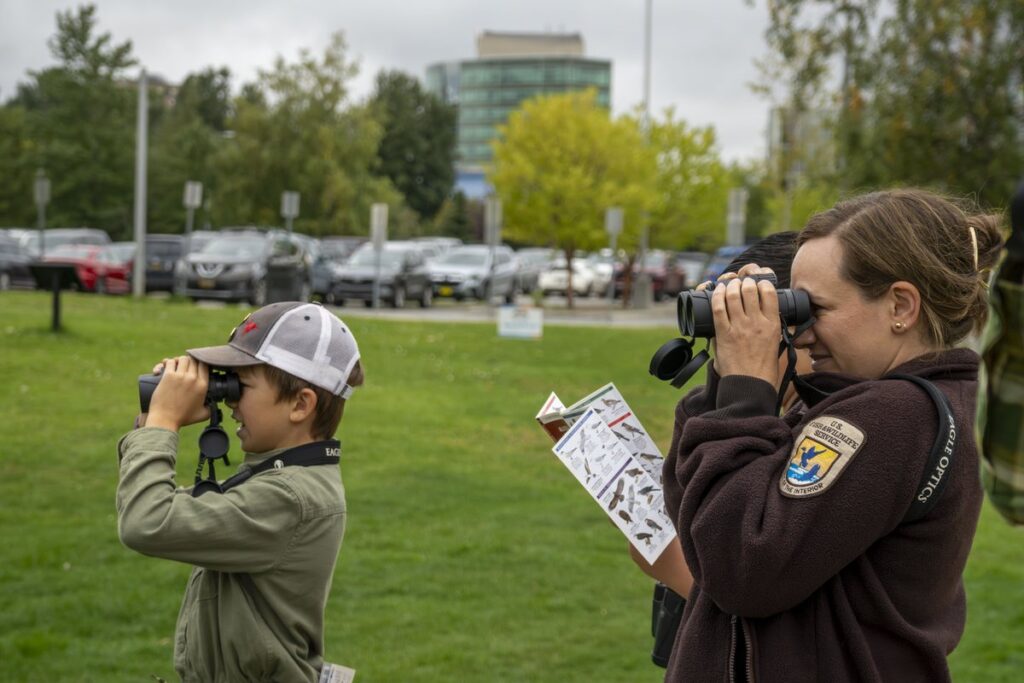
Real binoculars vs toy binoculars
Toy binoculars use plastic lenses that blur the view, and many under $10 break quickly, the Cornell Lab notes. Real binoculars have glass lenses and prisms and a center focus wheel. Expect to pay about $30 for a small real pair and $65–$120 for one that lasts years. For a toddler, a toy pair works as a prop, and Audubon even suggests two taped-together toilet paper rolls for practice.
Other features worth having
- Waterproofing: sealed binoculars survive rain, puddles and the occasional drop in a creek.
- Eye relief of 15 mm or more: lets kids who wear glasses see the whole view.
- A neck strap: keeps them out of the dirt. Most of these picks include one.
- A good warranty: Vortex covers accidental damage, which matters with kids.
How to teach a child to use binoculars
- Set the width. Do the fit test above so your child sees one circle.
- Practice on something still. Pick a sign or tree 15 to 20 feet away, as Audubon suggests.
- Look first, then lift. Have your child find the target with their eyes, then raise the binoculars without looking away. Scanning through the binoculars first makes things hard to find.
- Focus with the center wheel. Turn it slowly until the target is sharp.
- Move to birds. Start with slow birds at a feeder before trying flying ones.
- Take breaks. If frustration sets in, lower the binoculars, take a breath and try again.
The Cornell Lab also suggests printing a life-size bird silhouette and focusing on it from 15 feet away, then stepping back and forth to refocus. It’s a great rainy-day game.
Binoculars for kids FAQ
Can a 4-year-old use binoculars?
Yes, with a light 6x pair and an adult helping set the width. Audubon’s survey of parents and educators found that kids past preschool age can handle real binoculars. Younger toddlers do better with a toy pair.
What are some good real binoculars for kids?
The Vortex Bantam HD 6.5×32 for most kids, the National Geographic 6×21 on a tight budget, and the Kowa YF II 6×30 for a pair to grow into. All three have glass optics and fit narrow faces.
Which is better for kids, 8×42 or 10×42 binoculars?
8×42. It shows a wider, steadier view, and 10x magnifies every shake. Both are full-size and heavy for young kids, so an 8×30 or smaller usually suits children better.
What are the best binoculars for a 7-year-old?
The Vortex Bantam HD 6.5×32. It weighs under a pound and its eyepieces fold to 51 mm.
What are the best binoculars for teens?
The Nikon Prostaff P3 8×30, or a full-size 8×42 from our guide to the best binoculars for bird watching.
Can kids use binoculars for stargazing?
Yes. Any pair shows Moon craters and star clusters, and 50 mm lenses like the Cometron’s show much more. Binoculars are an easy first step before a telescope.
How much should I spend on kids’ binoculars?
About $30 for a first real pair and $65–$120 for one that lasts. Under $10 usually means plastic lenses.
Keep exploring
- More birding guides in our Nature hub
- Getting started: introduction to bird watching for beginners
- What’s at your feeder: common birds in Ohio and birds of North Carolina
- More ideas: what are the best hobbies for kids